Physical Address
Ahmedabad 380009
Physical Address
Ahmedabad 380009

From Selling Books in 2007 to a $16 Billion Walmart Deal: The Journey of Flipkart
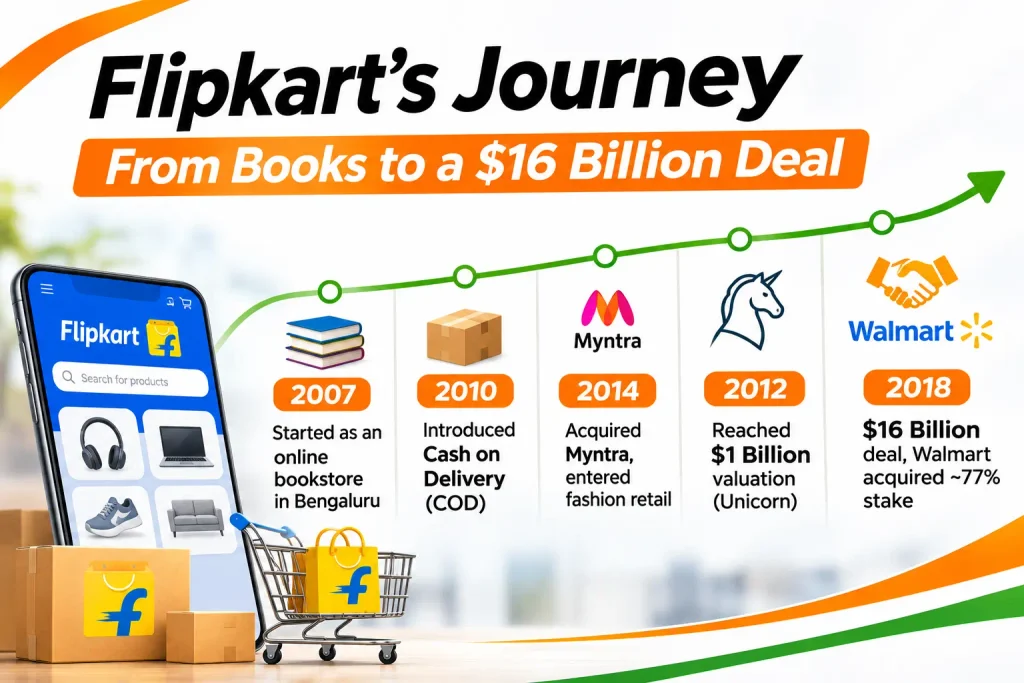
In 2007, when online shopping was still a relatively unfamiliar concept in India, two entrepreneurs identified an opportunity that would eventually transform the country’s retail industry. Their idea was to make books accessible to customers through an online platform. That small idea became Flipkart, one of India’s most influential e-commerce businesses.
Founded by Sachin Bansal and Binny Bansal, Flipkart started as an online bookstore in Bengaluru. Over the years, the company expanded into electronics, fashion, home appliances and several other product categories. Its focus on customer convenience, technology, logistics and digital payments helped it become a major force in Indian e-commerce.
The Flipkart growth story is an example of how identifying a market gap, understanding consumer behaviour and continuously adapting a business model can create a large-scale enterprise.
Flipkart was founded in October 2007 by Sachin Bansal and Binny Bansal, both graduates of IIT Delhi.
Before starting Flipkart, the two entrepreneurs had worked at Amazon in Bengaluru. Their experience in the technology and e-commerce industry helped them understand the potential of online retail.
At the time, India’s online shopping market was still developing. Most consumers preferred traditional retail stores, while internet access and online payment adoption were relatively limited.
Instead of entering multiple product categories immediately, the founders started with books.
Books offered a practical starting point because customers could search for titles online without necessarily needing to inspect the products physically.
The company initially operated with limited resources and a small team. Its early focus was on building an online platform, sourcing books and delivering orders to customers.
What began as a small online retail experiment gradually developed into a larger business opportunity.
One of Flipkart’s biggest early challenges was convincing Indian consumers to purchase products online.
Customers were often uncomfortable paying online before receiving their orders. Concerns about payment security, delivery reliability and product quality affected the growth of e-commerce.
Flipkart recognised that building trust was essential to expanding its customer base.
In 2010, the company introduced Cash on Delivery (COD), allowing customers to pay for their purchases when the products arrived.
This approach addressed an important barrier to online shopping, particularly among customers who were unfamiliar with digital payments.
Flipkart also invested in customer service, delivery operations and convenient shopping experiences.
The introduction of COD became an important part of its customer acquisition strategy and helped make online shopping more accessible to a wider audience.
The company was not simply selling products online; it was working to change how Indian consumers purchased them.
After establishing its presence in online bookselling, Flipkart gradually expanded into other product categories.
In 2010, it entered categories such as music, movies and mobiles. Over time, electronics, fashion, lifestyle and home products became important parts of its marketplace.
This expansion helped Flipkart reach a wider customer base and increase the range of products available through its platform.
However, growth required more than adding new products.
The company needed stronger technology infrastructure, supplier relationships, inventory management and delivery capabilities.
Flipkart invested in logistics and launched its dedicated logistics arm, eKart, to strengthen its delivery network.
Reliable delivery and customer service became important differentiators as competition in India’s e-commerce industry increased.
In 2014, Flipkart acquired Myntra, strengthening its presence in online fashion retail.
This strategic move helped the company expand its position in one of India’s important online shopping categories.
One of the important factors behind Flipkart’s expansion was its willingness to adapt its business model.
As the company grew, it evolved from its early online retail approach towards a marketplace model, connecting sellers with customers through its digital platform.
This approach enabled a broader selection of products and greater participation from sellers.
Technology played an important role in managing product discovery, customer experience, payments and marketplace operations.
Logistics also became a critical part of the business.
Through eKart and its delivery ecosystem, Flipkart worked towards improving order fulfilment and reaching customers across different parts of India.
The company’s growth highlighted an important lesson for e-commerce businesses: a successful online marketplace depends not only on its website or application but also on the operational infrastructure supporting it.
As Flipkart expanded, it attracted increasing attention from investors.
In 2009, Accel Partners invested approximately $1 million in the company, providing capital to support its growth.
Subsequent investment rounds helped Flipkart expand its operations, strengthen technology and compete in the growing Indian e-commerce market.
In 2012, Flipkart reached a reported valuation of approximately $1 billion, becoming one of India’s early unicorn startups.
A unicorn is a privately held startup valued at $1 billion or more.
The company continued attracting major investments from global investors, including Tiger Global, Naspers, Tencent and Microsoft.
By 2017, Flipkart had also received a significant investment from SoftBank Vision Fund.
These investments reflected growing international confidence in India’s digital commerce opportunity.
Flipkart’s journey became an important example for entrepreneurs and investors looking at the potential of India’s internet economy.
May 2018 marked a major turning point in Flipkart’s growth story.
Walmart announced an agreement to invest approximately $16 billion to acquire an initial stake of around 77% in Flipkart.
The transaction was completed on August 18, 2018, making Walmart the largest shareholder in the company.
The investment included approximately $2 billion in new equity funding intended to support Flipkart’s future growth.
This transaction became one of the most significant investment deals in India’s startup and e-commerce history.
For Walmart, the investment provided an opportunity to participate in India’s growing digital commerce market.
For Flipkart, it represented a major milestone after more than a decade of building its business.
The deal also demonstrated how an Indian-founded technology company could attract large-scale international investment.
Flipkart’s growth has extended beyond its original online marketplace.
Its business ecosystem has expanded to include platforms and services such as Myntra, Flipkart Wholesale, Cleartrip and super.money.
According to Flipkart’s corporate overview published in September 2025, the Flipkart Group reported more than 500 million registered users, approximately 1.4 million sellers and over 150 million products across more than 80 categories.
These figures demonstrate the scale of the ecosystem that developed from its original online bookstore.
The company has also highlighted its role in supporting sellers, small businesses and entrepreneurs through digital commerce.
Its journey reflects the broader development of India’s e-commerce industry, where technology platforms have created new opportunities for consumers and businesses.
Flipkart’s journey offers valuable lessons for startups and emerging businesses.
Start With a Specific Market Opportunity: Flipkart began with books instead of attempting to sell everything from day one. A focused starting point helped the company enter the market.
Understand Customer Problems: Cash on Delivery addressed a genuine concern among Indian consumers. Successful innovation often comes from solving practical customer problems.
Build Strong Operations: Logistics, customer service and reliable delivery were essential to supporting the company’s expansion.
Adapt Your Business Model: Flipkart evolved as the market changed, moving towards a marketplace model and expanding into new categories.
Think Beyond Initial Growth: Its journey demonstrates the importance of building technology, infrastructure and partnerships that can support long-term business expansion.
The Flipkart growth story demonstrates how a focused business idea can develop into a large enterprise through customer understanding, innovation and consistent execution.
What started as an online bookstore in Bengaluru in 2007 eventually became a major e-commerce ecosystem and attracted a landmark $16 billion investment from Walmart in 2018.
Flipkart’s journey is an important chapter in India’s startup history. It shows that building a successful business is not only about having a promising idea. It is also about understanding the market, solving customer problems and creating systems that can support sustainable growth.
For India’s emerging entrepreneurs, Flipkart offers a powerful reminder: Big businesses can begin with small ideas, but long-term growth comes from solving real problems.
This article is part of BizzUdaan’s “30 Days. 30 Unicorns.” series, exploring the growth journeys of India’s most influential startup businesses.
1. When was Flipkart founded?
Flipkart was founded in October 2007 by Sachin Bansal and Binny Bansal in Bengaluru, India.
2. What was Flipkart’s original business model?
Flipkart initially operated as an online bookstore, selling books through its website and delivering them to customers.
3. How did Flipkart attract customers in its early days?
The company focused on customer convenience, customer service and innovations such as Cash on Delivery, which helped address concerns about online payments.
4. When did Flipkart introduce Cash on Delivery?
Flipkart introduced Cash on Delivery in 2010 to make online shopping more accessible to Indian consumers.
5. When did Walmart acquire a stake in Flipkart?
Walmart announced its approximately $16 billion investment in May 2018. The transaction was completed on August 18, 2018, giving Walmart an approximately 77% stake.
6. What is Flipkart’s business model today?
Flipkart operates as a digital commerce marketplace connecting customers and sellers across multiple product categories.
7. Who are the founders of Flipkart?
Flipkart was founded by Sachin Bansal and Binny Bansal, both IIT Delhi graduates.
BizzUdaan is a business storytelling and digital media platform highlighting Indian businesses, startups, entrepreneurs and industry developments.
Through Growth Stories, Founder Stories and Business Insights, BizzUdaan aims to bring remarkable business journeys into the spotlight.
Have a business growth story worth sharing?
Get your business featured on BizzUdaan.
Website: www.bizzudaan.com
Email: info@bizzudaan.com