Physical Address
Ahmedabad 380009
Physical Address
Ahmedabad 380009

How Deepinder Goyal and Pankaj Chaddah turned a simple restaurant-menu website into a major player in India’s food-tech industry.
The Zomato Growth Story is an inspiring example of how a simple idea can grow into one of India’s most recognised food-tech businesses. In 2008, when finding restaurant information online was still difficult for many Indians, two colleagues — Deepinder Goyal and Pankaj Chaddah — launched a website that allowed people to browse restaurant menus.
Originally called Foodiebay, the platform was renamed Zomato in 2010. Over the years, the company expanded beyond restaurant discovery into food delivery, restaurant supplies and quick commerce.
From scanned menus to a major food-tech ecosystem, Zomato’s journey shows how understanding customer needs, embracing technology and adapting to market changes can shape a growing business.
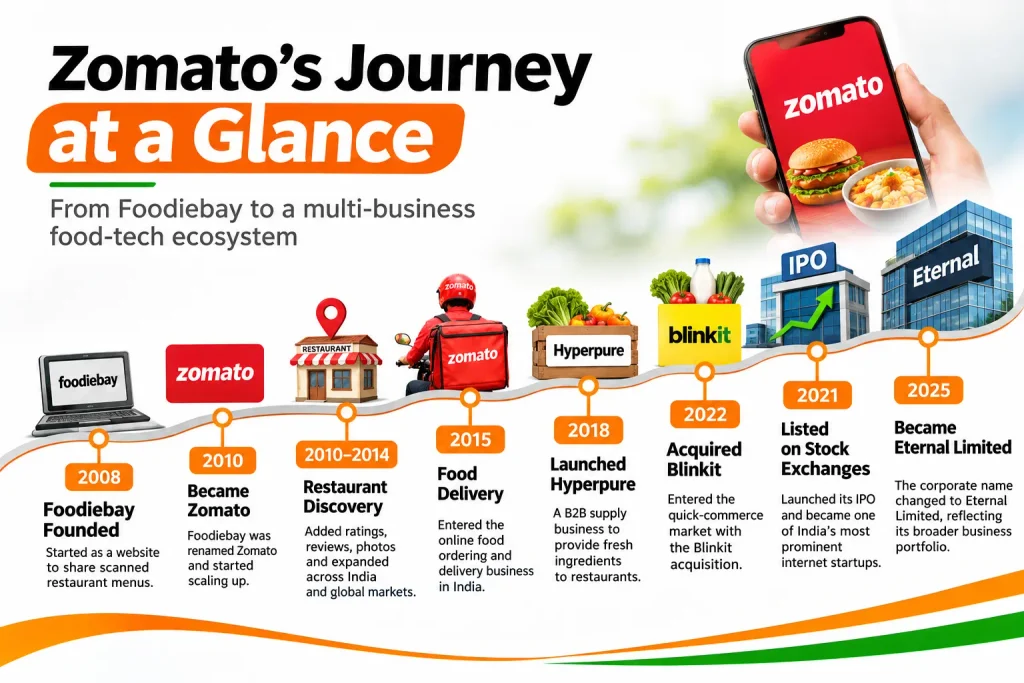
Here is how Zomato grew from a simple idea into a major food-tech business.
The story began in 2008, when Deepinder Goyal and Pankaj Chaddah were working at Bain & Company. They noticed a common problem: people often struggled to find restaurant menus and decide where to eat.
At the time, restaurant menus were commonly shared through printed flyers and physical copies. Finding information about different restaurants was not as convenient as it is today.
The founders started collecting restaurant menus, scanning them and uploading them online. Their website, Foodiebay, made it easier for users to explore menus before visiting or ordering from a restaurant.
In a 2018 blog post, Deepinder Goyal recalled how the early website was built outside their regular working hours. The initial operation was small, but it addressed a real everyday problem.
The idea was simple: make restaurant information accessible in one place.
As the platform grew, the founders began thinking beyond its original identity.
In 2010, Foodiebay was renamed Zomato. The new name gave the business room to expand beyond restaurant menu listings and build a broader food-focused platform.
The company also began expanding its restaurant coverage and attracting investment. Info Edge became an early investor, supporting the startup as it developed its product and expanded its presence.
This was an important shift. Zomato was no longer just a website containing scanned menus. It was building a platform around restaurant discovery and food-related information.
The lesson was clear: a startup’s original idea can become the foundation for a much bigger business when founders remain open to evolving it.
Zomato gradually developed its platform to offer more than menus.
Users could explore restaurants, check ratings and reviews, view photographs and discover places to eat. This helped make restaurant discovery more convenient and gave customers a way to make informed dining decisions.
For restaurants, the platform created another opportunity to reach potential customers and build visibility online.
The company was building a connection between two sides of the market: people looking for places to eat and restaurants looking for customers.
This discovery-led model helped Zomato build an audience and establish its brand in India’s growing internet economy.
Restaurant discovery helped Zomato attract users, but the company identified another opportunity: helping customers get food delivered to their homes.
As smartphone adoption, internet access and digital payments expanded in India, online food ordering became increasingly convenient.
Zomato entered the food delivery market and developed its platform around ordering, restaurant partnerships and delivery operations.
This was a major business-model expansion. The company was no longer limited to helping people decide where to eat. It was also becoming part of the actual ordering and delivery process.
Food delivery brought new operational challenges, including delivery logistics, restaurant coordination, customer experience and competition.
It also placed Zomato in a rapidly growing market where convenience and speed became important factors in customer decisions.
Zomato’s growth strategy was not limited to customers and restaurant discovery. It also looked at the supply side of the restaurant industry.
In August 2018, the company launched Hyperpure, a business focused on supplying fresh ingredients and other products to restaurants.
The idea was to help restaurants access quality ingredients through a more organised, technology-enabled supply chain.
In a March 2019 company blog post, Zomato explained that Hyperpure had expanded rapidly in Bengaluru after its launch. The business was already supplying hundreds of restaurants within its first few months.
This move was significant because it showed Zomato exploring opportunities across the restaurant ecosystem — not just the customer-facing side of food ordering.
It also demonstrated how an existing relationship with restaurants could create opportunities for additional services.
One of the biggest milestones in the company’s journey came in July 2021, when Zomato launched its initial public offering (IPO).
The IPO opened for subscription from July 14 to July 16, 2021, at an issue price of ₹76 per share. On July 23, 2021, Zomato made its stock-market debut.
Its shares opened at ₹116 on the National Stock Exchange, significantly above the issue price.
The listing attracted considerable attention because Zomato became one of the most prominent Indian internet startups to enter the public markets.
The IPO marked a new chapter for the company. It brought greater public-market visibility and placed the business under the expectations and scrutiny that come with being a listed company.
For India’s startup ecosystem, the listing was also an important moment. It demonstrated that technology-led consumer businesses could reach the public markets.
Zomato continued to explore new opportunities as consumer expectations changed.
In 2022, the company announced the acquisition of Blinkit, formerly known as Grofers, marking a significant move into quick commerce.
Quick commerce focuses on delivering groceries and everyday essentials within short time windows. It represented a different market from restaurant food delivery, but shared some important elements: local demand, technology, delivery networks and fulfilment operations.
The acquisition expanded the company’s presence in the convenience-led delivery market.
It also reflected a broader strategic direction: building businesses around changing consumer habits and the demand for faster access to products and services.
The move came with its own challenges, including intense competition, operating costs and the need to build sustainable unit economics.
Another major development came in 2025.
The company announced a change in its corporate name from Zomato Limited to Eternal Limited. The Registrar of Companies approved the change with effect from March 20, 2025. The National Stock Exchange subsequently announced that the trading symbol would change from ZOMATO to ETERNAL from April 9, 2025.
The change reflected the company’s broader business structure, which had grown beyond the Zomato food-delivery brand.
Importantly, Zomato continued to remain a consumer-facing brand. Eternal became the name of the parent company.
This distinction matters: the Zomato brand and the listed parent company are not the same thing following the corporate name change.
Zomato’s journey offers several lessons for entrepreneurs, founders and growing businesses.
Foodiebay began with a simple problem: restaurant menus were difficult to find. A clear customer problem can be a strong starting point for a business.
As people moved towards smartphones and online ordering, Zomato adapted its services. Businesses need to understand how customer expectations change over time.
Zomato’s moves into food delivery, Hyperpure and quick commerce show how a business can explore opportunities around its existing market. Expansion, however, needs careful execution and a sustainable business model.
A food-delivery platform needs more than an app. It also depends on restaurant partnerships, delivery operations, customer support and supply-chain management.
The transition from Foodiebay to Zomato, and later from Zomato Limited to Eternal Limited, reflects how businesses may need to change their identity and structure as they grow.
Zomato’s journey from a restaurant-menu website to a major food-tech business is an example of how a simple idea can evolve over time.
Deepinder Goyal and Pankaj Chaddah started by making restaurant menus easier to discover. The business gradually expanded into restaurant discovery, food delivery, restaurant supplies and quick commerce.
The journey also shows that startup growth is not simply about launching an app or attracting investment. It requires understanding customers, building strong operations, adapting to competition and making difficult strategic decisions.
For entrepreneurs building businesses in India, Zomato’s story offers an important reminder: start with a real problem, build something useful and keep evolving as the market changes.
Zomato’s journey began in 2008 with a restaurant-listing website called Foodiebay. The platform was renamed Zomato in 2010.
Zomato was founded by Deepinder Goyal and Pankaj Chaddah.
Zomato was originally called Foodiebay. It was renamed Zomato in 2010.
Zomato’s IPO opened for subscription on July 14, 2021, and closed on July 16, 2021. The company was listed on the stock exchanges on July 23, 2021.
Hyperpure is a business launched by Zomato in August 2018 to supply fresh ingredients and other products to restaurants.
Yes. Zomato announced its acquisition of Blinkit in 2022, expanding its presence into the quick-commerce market.
The corporate name was changed to Eternal Limited in March 2025 as the company’s business portfolio expanded beyond the Zomato food-delivery brand. Zomato continues to operate as a consumer-facing brand.
BizzUdaan is a business storytelling and digital publishing platform dedicated to highlighting India’s businesses, startups, entrepreneurs and emerging opportunities.
Through business stories, founder journeys and industry insights, BizzUdaan aims to give growing businesses a platform to share their journey and connect with a wider audience.
Visit: www.bizzudaan.com
Email: info@bizzudaan.com