Physical Address
Ahmedabad 380009
Physical Address
Ahmedabad 380009

India’s festive season is one of the country’s most important periods for retail businesses, e-commerce platforms and consumer brands. Diwali sales 2026 are expected to create significant opportunities across multiple industries, from clothing and electronics to gold, sweets and home décor, as consumers prepare for festive shopping and gifting.
However, the latest 2026 estimates suggest a more complicated picture. While India’s overall festive trade is expected to expand, a consumer survey indicates that urban households are planning to spend less than they did last year. The difference highlights an important question: Will Diwali sales grow because consumers are spending more, or because more transactions are taking place across the market?
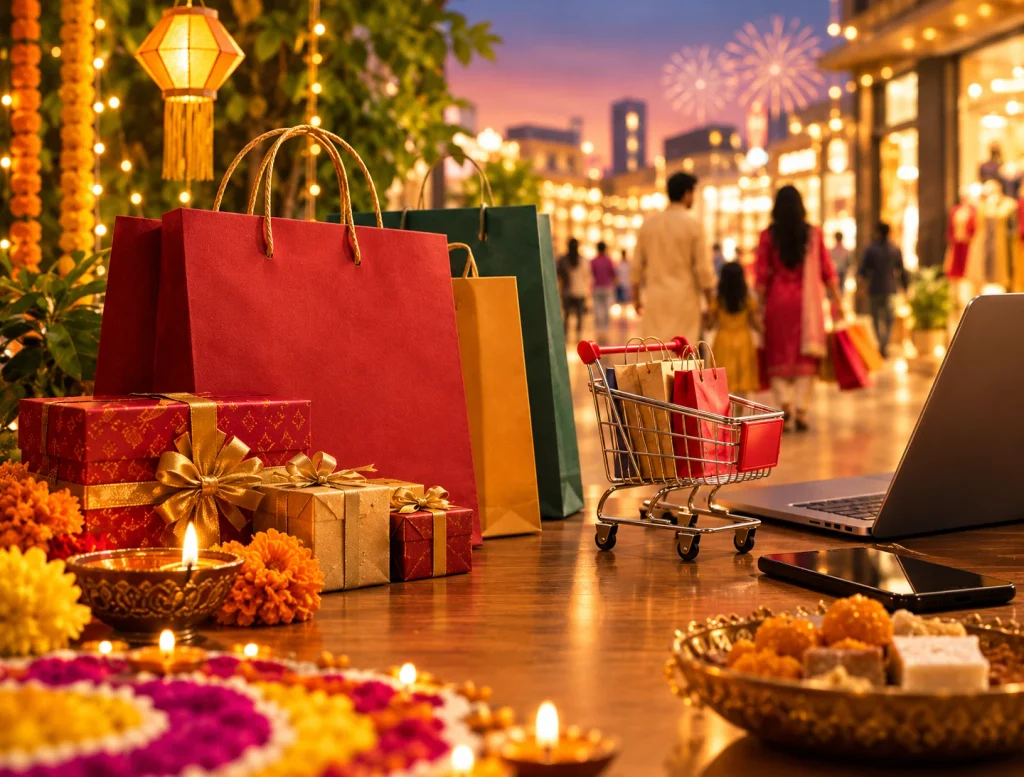
According to the Confederation of All India Traders (CAIT), India’s festive trade between Navratri and Diwali could exceed ₹7 lakh crore in 2026, representing estimated growth of 15–18% over the previous year. This is an industry projection, not a final audited sales figure. Source: Business Today.
Meanwhile, a LocalCircles survey presents a different perspective on household spending.
The survey, which collected more than 67,000 responses from urban consumers across 307 districts, estimates that urban households will spend approximately ₹1.97 lakh crore on discretionary purchases during the September–November 2026 festive season. This is 6% lower than the estimated ₹2.10 lakh crore in 2025.
The findings suggest that higher overall market activity does not necessarily mean every household is increasing its spending.
These estimates also measure different things. CAIT’s projection covers broad festive trade, while LocalCircles estimates urban household discretionary spending. They should not be directly compared as if they represent the same market.
LocalCircles estimates that urban Indian households planning festive purchases will spend around ₹20,000 on average during the festive season.
Its survey also found that:
The survey also found that 83% of households planning festive purchases expected to use savings to fund at least part of their spending.
These figures indicate that festive shopping remains important, but household budgets and purchase priorities matter. Businesses cannot assume that every consumer will increase spending simply because the festive market is large.
Source: LocalCircles festive spending survey.
E-commerce is another important part of the festive economy.
According to Datum Intelligence’s Festive Barometer 2026, online festive sales during the major e-commerce sale window are forecast to reach approximately ₹1.50 lakh crore to ₹1.55 lakh crore, representing expected growth of 25–29%.
The forecast covers the festive online shopping window associated with major platforms such as Amazon and Flipkart. It does not represent total Diwali spending across India.
Datum also expects growth to be driven by more orders rather than simply larger average shopping baskets. If this forecast materialises, it would highlight the importance of inventory availability, product selection and efficient delivery.
For online retailers, attracting customers is only one part of the challenge. Businesses must also ensure that popular products remain available and orders reach customers on time.
Source: Datum Intelligence Festive Barometer 2026.
Several industries traditionally experience increased demand during India’s festive period.
Clothing, footwear and accessories are leading planned purchase categories in the LocalCircles survey. Retailers can benefit from festive collections, gift purchases and seasonal promotions, although results will vary by price range and location.
Gold and jewellery remain important purchases for many households during Dhanteras and Diwali. However, high prices can affect the quantity consumers purchase and their choice between jewellery, coins and other products.
Consumers often consider smartphones, televisions, kitchen appliances and other electronics during festive sales. Discounts, exchange offers, financing options and product launches can influence purchasing decisions.
Festive celebrations create demand for sweets, packaged foods, dry fruits, gift hampers and corporate gifting. Local manufacturers and small businesses can participate through customised products and direct-to-consumer sales.
Online marketplaces, delivery services, warehouses and packaging providers support the wider festive shopping ecosystem. Higher order volumes can create opportunities for these businesses, although operating costs and delivery capacity remain important considerations.
These categories represent potential opportunities, not a guarantee that every industry or retailer will record growth in 2026.
For small businesses, the biggest lesson from Diwali sales 2026 is that market size alone does not determine success.
When consumers become more selective, businesses need to understand what their customers actually want and how much they are willing to spend.
There are several practical steps businesses can take:
Understand customer budgets: Offer products across different price points rather than relying entirely on premium purchases.
Promote products with a clear purpose: Explain the benefits, quality and value of products instead of depending only on festive discounts.
Prepare inventory carefully: Use previous sales data and current customer enquiries to estimate demand and reduce the risk of overstocking.
Strengthen digital visibility: Use social media, search engine optimisation, local business listings and relevant online advertising to help customers discover products.
Measure actual performance: Track orders, conversion rates, average order value and repeat purchases. High website traffic or social media engagement does not automatically translate into sales.
For smaller retailers, a focused marketing strategy can be more useful than trying to compete with large brands on discounts alone.
India’s Diwali sales outlook for 2026 reflects two different trends. CAIT expects overall festive trade to exceed ₹7 lakh crore, while LocalCircles estimates a 6% decline in urban household discretionary spending compared with 2025. At the same time, Datum Intelligence forecasts strong growth in online festive sales.
Together, these estimates suggest that the festive market cannot be understood through a single number. Overall trade, household budgets and online order volumes each tell a different part of the story.
For businesses, the opportunity lies in understanding consumer demand, offering appropriate value and reaching customers through the right channels. For consumers, spending decisions will continue to depend on household budgets, product prices and individual priorities.
The final picture will become clearer when post-festive sales data is available.
At Bizzudaan, we follow the business trends, market shifts and consumer behaviour shaping India’s growth story.
Editorial note: Figures in this article are attributed estimates and forecasts published before Diwali 2026. They should not be interpreted as final sales results.
……..