Physical Address
Ahmedabad 380009
Physical Address
Ahmedabad 380009

Skyroot Aerospace has done what only governments once could. On 18 July 2026, its seven-storey Vikram-1 rocket lifted off from Sriharikota and placed payloads into orbit on the first attempt. Just ten weeks earlier, the Hyderabad company had become India’s first space-tech unicorn. This growth story shows how Skyroot Aerospace got there, and what any business can learn from it.
Great growth stories often begin when a door opens. For Indian space, that door was the 2020 reform that let private companies build rockets and use ISRO’s facilities. Before that, a private launch company in India was almost unthinkable.
Skyroot Aerospace walked through that door early. Instead of picking an easy product, it chose orbital launch vehicles, the hardest category in the industry. Its target was the small-satellite market, which keeps growing as telecom, earth-observation and defence players launch more and smaller satellites.
The promise was simple. Give satellite operators a dedicated ride to space, so they do not have to wait for a spot on someone else’s rocket.
The company did not try to reach orbit in one leap. Instead, it earned trust in stages, and each stage unlocked the next.
First came engine tests. In August 2020, Skyroot successfully tested Raman, the upper-stage engine of its planned orbital rocket. Over the following years, it moved on to carbon-fibre motor cases, pressure tests on its first stage and long burns of a 3D-printed cryogenic engine.
The big proof point arrived on 18 November 2022. Vikram-S, a suborbital rocket, flew from Sriharikota on a mission called Prarambh, meaning “beginning”. It became the first privately built Indian rocket to reach space. The flight was short, yet it showed that an Indian startup could design, build and launch a rocket.
The lesson is clear. Vikram-S was not the final product. It was a proof point that made investors, customers and partners take the bigger plan seriously.
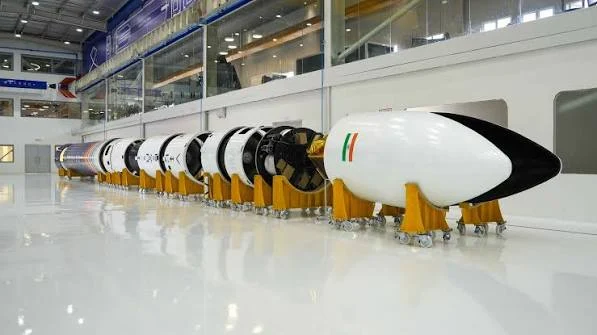
Anyone can build one rocket with enough effort. Building many is what turns a project into a business. Therefore, Skyroot invested early in manufacturing. It now runs four facilities in Hyderabad, and its Infinity campus can build one rocket a month.
The design choices point the same way. Vikram-1 uses an all-carbon-composite body, which is lighter than steel and more fuel efficient. It also relies on in-house propulsion, including 3D-printed engines and solid-fuel boosters. Reports put the vehicle at about 95 per cent indigenous, which means fewer imported parts and fewer supply-chain delays.
Even the long-term goal sounds like manufacturing, not research: a 72-hour gap between assembly and launch. At Bizzudaan, we see this pattern again and again. The businesses that scale are the ones that build systems, not just products.
Funding followed proof. After a 2023 round, Skyroot Aerospace was valued at about half a billion dollars. Then, on 7 May 2026, it announced a raise of nearly $60 million led by Sherpalo Ventures and Singapore’s sovereign fund GIC. Funds managed by BlackRock, the founders of Greenko Group and Arkam Ventures also took part.
The round valued the company at $1.1 billion before the new money, more than double the earlier mark. Total funding crossed $160 million, or roughly Rs 1,500 crore.
Timing mattered. The money arrived weeks before the planned launch, when investors could already see a flight-ready rocket on the pad. The company planned to spend it on three things: more Vikram-1 launches, bigger manufacturing capacity and the development of Vikram-2.
On 18 July 2026, Mission Aagaman, meaning “arrival”, lifted off from the first launch pad at the Satish Dhawan Space Centre. Vikram-1 flew a clean profile. About fifteen minutes later, its final stage placed the payloads into an orbit of roughly 450 km.
Those payloads included Skyroot’s own SCOPE satellite and Grahaa Space’s Solaras satellite, along with in-orbit experiments from Indian and German partners.
The result was historic for three reasons. First, Skyroot became the first Indian private company to reach orbit, and it did so on its first attempt. Second, India joined the United States and China as a country with private orbital launch capability. Third, the flight carried a mix of domestic and international customers, so the market was already paying attention.
One successful flight is a beginning, not a finish line. Skyroot has called Aagaman a test flight and says more test flights will follow before routine commercial service. Vikram-1 is rated for about 350 kg to low Earth orbit. The company has also spoken of four to six launches in a financial year as it ramps up.
Vikram-2 is the next big step. This larger vehicle, powered by an advanced cryogenic stage, is expected to carry roughly 900 kg to one tonne, with a debut reportedly around 2027.
However, the small-launch market is crowded with global players. Reliability and cadence will therefore decide the winner. Launching often, on schedule and without failures is where Skyroot’s factory-first approach should pay off, and Bizzudaan will be watching that journey closely.
The Skyroot Aerospace story is bigger than one company. It shows that Indian startups can win in deep technology, not only in apps and consumer services. It also shows what patient capital, supportive policy and strong engineering can create together.
Most of all, it reminds the next generation of Indian entrepreneurs that a billion-dollar company can begin with a bold idea, grow one proof at a time and end up with a rocket in orbit. This is exactly the kind of story we love to tell at Bizzudaan: ambition backed by proof, and pride in what Indian businesses can build.
Want more business growth stories like this? Read them on Bizzudaan, and share your own business story with us.