Physical Address
Ahmedabad 380009
Physical Address
Ahmedabad 380009

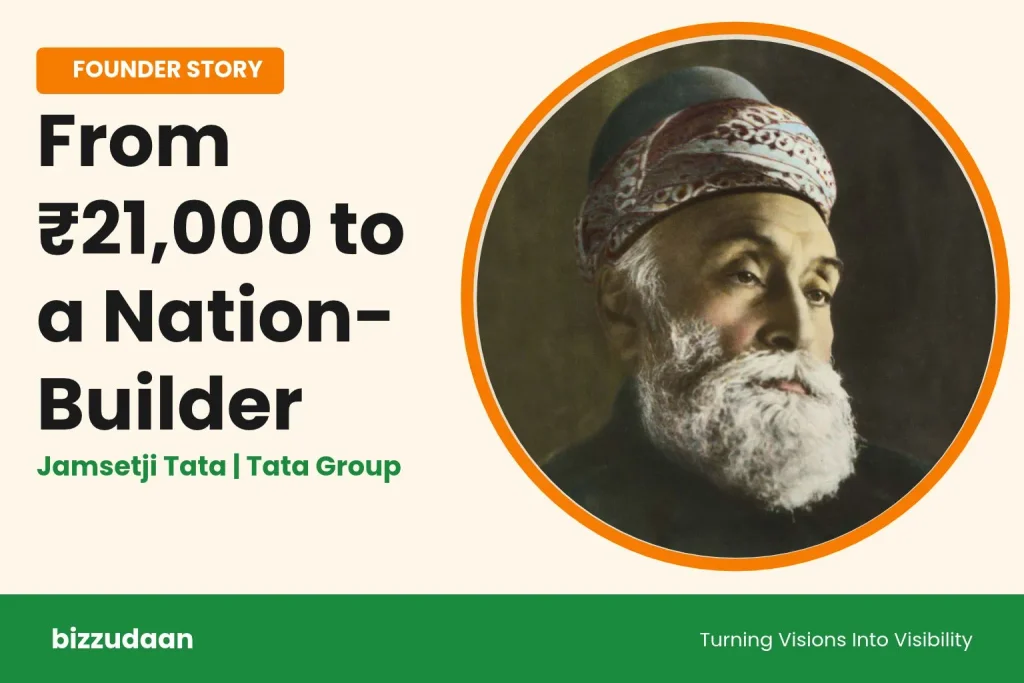
Friends, some people do business to earn money. Some do business to build a nation. Jamsetji Tata belonged to the second kind. This is the Jamsetji Tata story, the story of a boy from Navsari who started with just ₹21,000 and a very big dream. In an age when India was not even free, he dared to dream of steel, power, science and a world-class hotel for his countrymen. He is remembered today as the founder of the Tata Group and the father of Indian industry. His life proves that you don’t need a perfect start to create a great legacy, only a clear vision and the courage to begin. So come, let us read how a man with a small trading firm laid the foundation of modern India.
It was the year 1839, in the small Gujarati town of Navsari. A baby boy was born in a Parsi priestly family, and he was named Jamsetji Nusserwanji Tata.
In that family, everybody was a priest. But his father, Nusserwanji, did something nobody expected. He left the traditional path, moved to Bombay, and became the first businessman of the family. That one brave decision planted the seed of the Tata story.
Now imagine those days. India was under British rule. An Indian could become a clerk or a small trader, and that was considered a very good life. But steel, shipping, big factories? Those were for the “sahibs.” For an Indian to dream big was almost a crime.
But Jamsetji dreamt anyway. And what dreams they were! They stretched not for years, but for centuries.
He studied at Elphinstone College and joined his father’s trading firm in 1858. Those were not glamorous years. They were years of learning. He travelled to China, to England, and to many other places, and he saw with his own eyes how the world’s factories ran.
When he saw the great mills of Manchester, one question kept pricking his heart: “The cotton grows in our fields. Then why does England take all the profit?”
At just 29 years of age, in 1868, he started his own trading company with a capital of only ₹21,000. Not a crore, not even a lakh. Just ₹21,000, a big heart and a bigger vision.
There were failures on the way. People laughed, and people doubted. But Jamsetji had something more valuable than money: patience and a far-sighted vision.
In 1869, he bought a sick oil mill at Chinchpokli in Bombay, turned it into a cotton mill, and sold it for a good profit a couple of years later. Then he took a much bigger gamble.
In 1874, he laid the foundation of a mill in Nagpur, which started running in 1877. That was the year Queen Victoria was declared Empress of India, so he named it the Empress Mills.
People said, “Nagpur? So far from the sea and the Bombay ports? Has he lost his mind?” But Jamsetji had done his homework. The cotton fields were nearby, so the costs would be low and the quality high.
And here is the beautiful part. He did not just build a mill. He built a way of thinking. Workers were not treated as mere servants. Tata companies became known for taking care of their people, with provident funds, accident compensation, and in later years the eight-hour working day and maternity benefits, much before many others did.
For Jamsetji, a worker was not a pair of hands. He was a partner in nation-building.
In 1886, he took over a mill at Kurla and gave it a name that says everything: Swadeshi Mills.
Remember, this was years before the Swadeshi movement shook the country in 1905. Jamsetji was already telling the world, not with speeches but with his work: “We Indians can make world-class goods, and Indian money must build India.”
His goal was not to make cheap cloth. He imported better cotton and better machines, because he wanted the label “Made in India” to mean excellence.
Jamsetji had four big dreams. Each looked impossible in his time.
1. A world-class steel plant. Steel is the backbone of any industrial nation, and the British were not happy to see Indians make it. Jamsetji spent years in the search for iron ore and coal. That search led his team to the area that later became Jamshedpur. He did not live to see it. Tata Steel was founded in 1907 and produced its first steel in 1912.
2. Hydroelectric power. He dreamt of clean power for Bombay’s mills from the rain-fed Western Ghats. His sons turned this into reality, and Tata Power began in the early 1910s.
3. A great institute of science. He believed that a country without research would stay dependent forever. He gave generously towards what became the Indian Institute of Science, Bangalore, established in 1909, after his death. Even today it stands among the top research institutions of India.
4. A grand hotel. In 1903, the Taj Mahal Palace opened on the Bombay waterfront. It was the first Indian-owned luxury hotel, built to a standard equal to the best in the world.
There is a famous story that Jamsetji was once refused entry to a “Europeans-only” hotel, and that he answered by building a grander one. Historians debate whether it really happened, so we call it a popular legend. But the pride behind the Taj is very real. An Indian built a palace for the whole world to visit.
He also began a scholarship in 1892 to send talented Indian students abroad for higher studies. Many of them rose to become leaders in their fields.
Jamsetji Tata passed away on 19 May 1904 in Germany. Of his four dreams, only the Taj was complete in his lifetime. Steel, power and the institute were still on paper.
But the dreams did not die with him. His sons, Dorabji and Ratanji, and the strong team he had built, carried every dream to completion. Today the group he began is one of the biggest and most respected business houses in India. A major share of its ownership is held by charitable trusts, so a large part of the wealth it creates goes back to education, health and research.
This is the real Tata difference: profit was never the final goal. The nation was.
Just think about it, friends. When Indians were told “you cannot make steel,” he built a steel city. When people said India could not run a world-class hotel, he built the Taj. When the country had very few research centres, he helped create a temple of science.
He did not wait for freedom to start building a free India. He laid the foundations of Atmanirbhar Bharat long before the word was even invented. He proved that Indians can stand shoulder to shoulder with the world, with honesty, quality and heart.
Later generations carried the same flame forward. J.R.D. Tata started Tata Airlines in 1932, which later became Air India. Ratan Tata took the group to the global stage. Today Tata tea, steel, software and cars travel the world with an Indian name proudly on them.
Most people see Tata today as a giant. But remember, Jamsetji began with a small trading firm and a very big idea.
Here is our take for every young Indian entrepreneur: do not wait for the perfect time, perfect capital or anybody’s permission. Jamsetji started when India was not even free and nobody believed in Indian industry. He did not build for quick profit. He built for the next hundred years, and that is exactly why we still take his name with respect.
Also notice what he did differently. He looked after his workers, spent on education, and kept the country’s growth beside his own. In today’s world of fast money and quick exits, his life reminds us that trust lasts longer than money, and a brand built on values becomes a legacy.
If a man in 1868 could dream of steel, science and power for a country that did not even own itself, then what is our excuse today?
Friends, if the Jamsetji Tata story inspired you, remember that every big business once started as a small dream. Maybe you too are building something in your town, with limited money but unlimited junoon. At Bizzudaan, we believe every Indian entrepreneur, startup and young dreamer deserves a stage. If you have a story of struggle, courage and growth, please share your story with us, and we will bring it to lakhs of young Indians. Who knows, the next zero-to-hero story on Bizzudaan could be yours!
👉 Share your story with Bizzudaan
Bizzudaan: Turning Visions Into Visibility.
Jai Hind. Jai Udaan.